


The third entry into the New York Times bestselling series, To Challenge Heaven brings another thrilling adventure from the masters of military science fiction, David Weber and Chris Kennedy. In a universe teeming with predators, humanity needs friends. And fast. We've come a long way in the forty years since the Shongairi attacked Earth, killed half its people, and then were driven away by an alliance of humans with the other sentient bipeds who inhabit our planet. We took the technology they left behind, and rapidly built ourselves into a starfaring civilization. Because we haven't got a moment to lose. Because it's clear that there are even more powerful, more hostile aliens out there, and Earth needs allies. But it also transpires that the Shongairi expedition that nearly destroyed our home planet ... wasn't an official one. That, indeed, its commander may have been acting as an unwitting cats-paw for the Founders, the ancient alliance of very old, very evil aliens who run the Hegemony that dominates our galaxy, and who hold the Shongairi, as they hold most non-Founder species, in not-so-benign contempt. Indeed, it may turn out to be possible to turn the Shongairi into our allies against the Hegemony. There's just the small matter of the Shongairi honor code, which makes bushido look like a child's game. We might be able to make them our friends -- if we can crush their planetary defenses in the greatest battle we, or they, have ever seen...
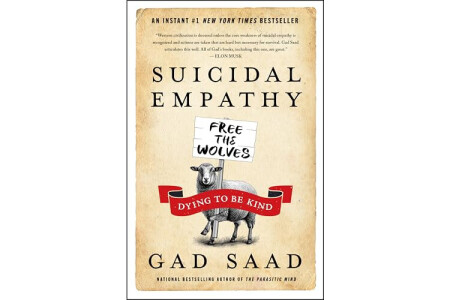
AN INSTANT #1 NEW YORK TIMES BESTSELLER The bestselling author of The Parasitic Mind shows why empathy in politics leads to civilizational collapse. What happens when a society elevates victimhood to a virtue and decides that punishment is cruel? You get the disease Dr. Gad Saad calls suicidal empathy. And the West may be terminally infected. In his new book, Suicidal Empathy, Saad unleashes a blistering critique of maladaptively irrational altruism that has gripped our culture. This mind parasite hijacked the empathy module of our progressive elite, leading to a catastrophic miscalibration of moral priorities. The results are everywhere: from coddling violent criminals to protecting rapists to branding self-defense as toxic behavior. We are witnessing a civilization in rapid decline. Lunatic policies are instituted because we prioritize the feelings of ostensibly marginalized groups over The Truth, criminals over victims, and squatters over homeowners. This is not humane; it’s an active dismantling of the pillars that keep us safe and free. This crisis of empathy creates a horrifying system of inverse morality where the strong and successful are demonized, and the destructive are celebrated. Just look at the insane inversions we tolerate daily: we prefer illegal migrants over our own legal citizens and veterans, permit drug addicts to threaten children’s safety in parks, and elevate transgender 'women' above biological women in sports and safe spaces. Common sense is dying in a deluge of misguided compassion. Suicidal Empathy is your wake-up call. Stop ignoring your survival instincts in the name of political correctness. This isn't just misguided policy; it is the ultimate expression of a culture actively choosing its own demise.

2021 Hardcover Reprint of the 1949 Edition. Exact facsimile of the original edition, not reproduced with Optical Recognition Software. "Human Action: A Treatise on Economics" is the first comprehensive treatise on economics written by a leading member of the modern Austrian school of economics. Von Mises' contribution was very simple, yet at the same time extremely profound: he pointed out that the whole economy is the result of what individuals do. Individuals act, choose, cooperate, compete, and trade with one another. In this way Mises explained how complex market phenomena develop. Mises did not simply describe economic phenomena - prices, wages, interest rates, money, monopoly and even the trade cycle - he explained them as the outcomes of countless conscious, purposeful actions, choices, and preferences of individuals, each of whom was trying as best as he or she could under the circumstances to attain various wants and ends and to avoid undesired consequences. Hence the title Mises chose for his economic treatise, "Human Action."

There are products from different external stores in your basket, so a wish for each external store will be created.
Note: You will be able to configure each wish individually before publishing it.

 Spanish
(Español)
Spanish
(Español)
 German
(Deutsche)
German
(Deutsche)
 French
(Français)
French
(Français)
 Italian
(Italiano)
Italian
(Italiano)
 Portuguese
(Portugues)
Portuguese
(Portugues)

